
2030 Broadening Participation Pledge

Throughout the decade, as SRC defines, selects, and manages its research and education programs, we will look to grow our student base, establish a balanced mix of bachelors, masters, and Ph.D.-level initiatives, and create a more diverse and inclusive community.  


Report: Year 4 - SRC's Commitment to America's Workforce

Friday, April 4, 2025

Dear Colleague,

In April of 2021, we announced our Broadening Participation Pledge to “grow our student base, establish a balanced mix of Bachelor’s, Master’s, and Ph.D.-level initiatives, and create a more diverse and inclusive community” throughout the decade. As we reflect on this pledge, it is good to note the strides we have made and the challenges that remain. You can track the progress of SRC’s Research Scholar population table at https://www.src.org/about/broadening-participation/.

Times change, technologies change, administrations change, but one thing doesn’t: employers need well-educated, practically-experienced, creative talent to achieve their goals. In the semiconductor industry, SRC has been fostering the talent pipeline for more than 40 years by educating students through our highly competitive, industry-sponsored research projects. Students are exposed to real-world problems and work directly with industry to solve them, graduating with skills, experience, and a robust professional network. This not only puts them strides ahead of their peers but also equips them with valuable industry contacts and effective networking skills.

With the launch of the SMART USA Institute, SRC embarks on a new era for the entire nation. As part of the Manufacturing USA network of institutes, SMART USA is dedicated to reshoring, onshoring, and friendshoring semiconductor manufacturing in the US while filling the talent pipeline with the best and brightest.

To accomplish the aggressive goals laid out by SMART USA, it is incumbent on us to cast a wider net. According to the Semiconductor Industry Association’s “Winning the Chip Race” policy recommendations, the semiconductor industry needs to add 114,800 jobs by 2030. There is a projected gap of 67,000 or more new jobs in manufacturing and design that will go unfilled by 2030. The gap for technicians alone is projected to be 26,400.  

Here’s where our broadening participation pledge comes in. While we do not participate in diversity hiring initiatives, we are committed to tracking student demographics to better understand the reach and impact of our research programs. By monitoring and analyzing these statistics, we aim to ensure that our programs are accessible to a broad range of students while meeting the needs of employers.

The talent gap is tangible. According to a recent article from Engineers and Architects of America, “only about 20% of engineering graduates are women.” The data from 2024 indicates that women in SRC research are represented at levels similar to these national statistics. Women in engineering and science represent an incredible, untapped potential for innovation. Given the economic needs of the country, it is imperative to include women in these fields, much like how women significantly contributed to manufacturing roles during World War II, driving unprecedented levels of productivity and innovation. Their inclusion is not just a matter of equity but a necessity for driving progress and sustaining economic growth. We believe that students of all backgrounds should feel comfortable and safe pursuing their chosen career.

In recent years, we have made significant strides in fostering a more transparent community. One of the key indicators of this progress is the reduction in the number of students who choose not to report metrics. Historically, about 30% of the student population would choose not to report their demographic information. As of 2024, this had dropped to just over 20%. This suggests that students feel more comfortable and confident in reporting this data. This improvement could also be attributed to effective communication strategies implemented by SRC to emphasize the importance of accurate data collection.

Over the past year, we have observed a dynamic shift in the composition of our student body. While the overall number of students has increased, the percentage of Doctorate students has risen from 66% in 2023 to 71% in 2024. This increase, although indicative of our strong support for Ph.D. candidates, highlights an imbalance in our student population. Several factors have contributed to this change. The year 2024 marked the second year of the JUMP 2.0 program, which may have led some Master's students to complete their degree and move on to their Doctorate studies. Additionally, while we encourage research PIs to stretch their research dollars by including undergraduates in their projects, many research initiatives require doctorate-level students to drive the work.

We have been taking steps to increase the number of Bachelor's students through programs like the Undergraduate Research Program, which supports nearly 80 Bachelor's students. This seed program will be expanded up on in the SMART USA Institute. With an expected talent gap of 9,900 Bachelor’s graduates, the sky's the limit for our efforts to develop and scale these initiatives, ensuring we meet the growing demand for skilled professionals in the industry.

The JUMP 2.0 program has also partnered with NSF to co-sponsor 24 Research Experience for Undergrads sites focused on semiconductor sciences. Each of these programs will sponsor approximately 10 students for three years, with some cohorts beginning in 2023 and others yet to start. These initiatives demonstrate our dedication to fostering a pipeline of U.S. citizens, which is becoming more crucial in critical and emerging technologies (CET). For example, member companies in the Defense Industrial Base, such as Boeing and RTX Corporation, often have stringent hiring requirements, including a preference for U.S. citizenship, due to the sensitive nature of their work and compliance with federal regulations. We are confident that our efforts will lead to a more balanced mix of Doctorate and Master's students in the future.

To meet the national hiring needs in the semiconductor industry, it is crucial to attract talent from untapped pools, such as remote areas of the country, rural populations, and veterans. Educating, training, and hiring U.S. citizens is integral to the SMART USA Institute. Workforce development activities will focus on programs that attract a growing number of undergraduate students to pursue courses and career opportunities in the semiconductor industry. Increasing undergraduate interest in this field will boost the talent pool for the industry and encourage more students to pursue higher education and careers in academia. While great talent can come from all over the world, 32% of students working on SRC research projects are U.S. citizens (up from 23% in 2023).  

With decades of experience in preparing the workforce of tomorrow, SRC is poised to deliver the next generation of talent for the success of the US and like-minded nations.

Dr. Todd Younkin, President and CEO

2021 Broadening Participation Pledge Issued

2021 Report: Year 1 - The Seeds of Change

2022 Report: Year 2 - Slow Yet Visible Improvement

2023 Report: Year 3 - Gains in Undergraduate and Master Students


SRC Scholar Population
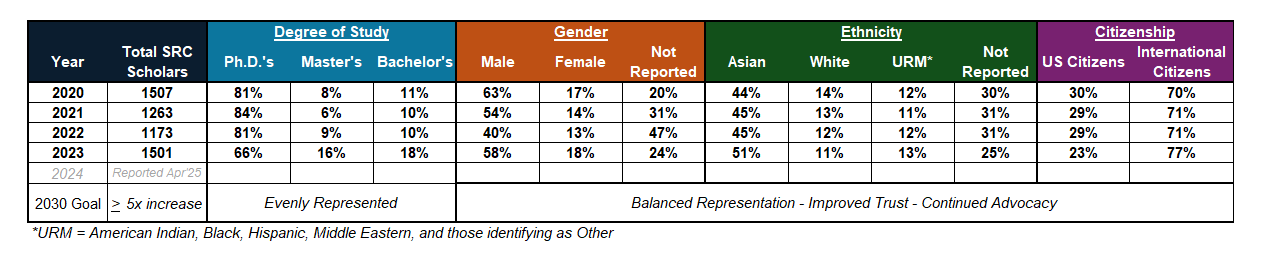
A chart detailing SRC student statistics

4819 Emperor Blvd, Suite 300 Durham, NC 27703 Voice: (919) 941-9400 Fax: (919) 941-9450

Important Information for the SRC website. This site uses cookies to store information on your computer. By continuing to use our site, you consent to our cookies. If you are not happy with the use of these cookies, please review our Cookie Policy to learn how they can be disabled. By disabling cookies, some features of the site will not work.